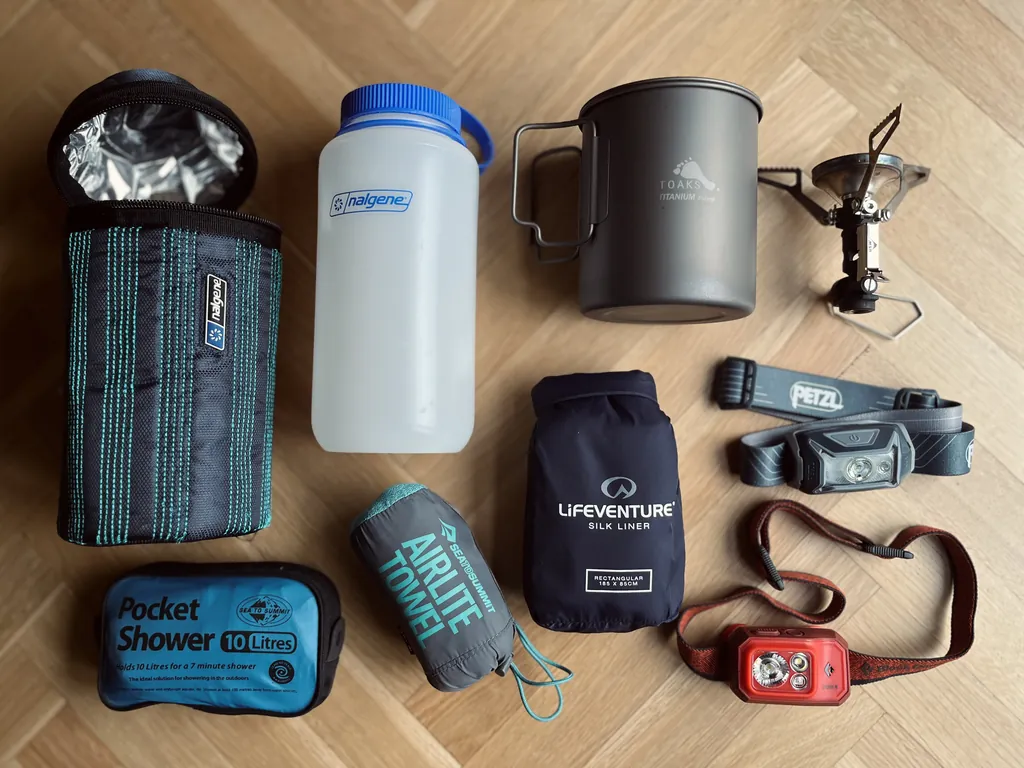
The Lightweight Gear Essentials I Actually Use
In the spirit of not wasting money on gear, here’s my personal list of small and lightweight items that consistently prove their value. No gimmicks – just compact gear that makes long days in the mountains easier, cleaner, and more comfortable.
The Lightest Insulated Water Bottle Setup
Most people think any bottle or thermos – yours or your grandmother’s – will do. And for casual use, that’s true. But once you’re carrying technical gear and every gram starts to matter, “any bottle” becomes dead weight.
My go-to combo is a Nalgene Wide Mouth Ultralite (~€10) plus an insulated sleeve (~€20). Together they weigh only 205 g (110 g bottle + 95 g sleeve), keep water from freezing (tested at -40°C), sit comfortably in or outside the pack, and the bottle can be used separately in positive temperatures. Cheap, durable, and stupidly effective. After going through metal double wall bottles and bulky thermoses – this is the one setup that keeps proving itself.
Best Headlamps for Hiking & Climbing
The “mine shines brighter than yours” argument could fill a whole forum, but for general use, the Petzl Tikka (~€25) is hard to beat. A reliable 350 lm, red light, long battery life, and available practically everywhere. For camp chores, trails, and evening use – perfect.
For technical pathfinding or climbing in the dark, the Tikka becomes limiting. Enter the Black Diamond Storm 500-R: 500 lm, excellent beam, and a fantastic rechargeable battery that handles cold well. It costs over twice as much as the Tikka (~€60), but you’re paying for real performance where it actually matters.
Pocket Shower for Multi-Day Trips
Believe it or not, this became one of the best “luxury” items in my pack. Mixing a liter or two of hot water with cold stream water, hanging it on a branch, and taking a real shower after days of dust, sweat, or tent grime – that’s priceless. Or just leave it in the sun for a couple of hours and it warms itself.
The Sea to Summit Pocket Shower weighs 120 g, packs absurdly small, and has surprisingly tough seams and straps. I paid 10€ for mine, and it might be the most comfortable and luxurious 10€ I’ve ever carried.
Ultralight Travel Towel
Out of all the small things, this one is a true essential. Heavy towels are dead weight. Slow-drying towels are misery. The Sea to Summit Airlite (size L: 67 g, ~€15) dries fast, doesn’t stink up too easily, and requires no pack space at all. It costs little and works better than most “travel towels” I tried before. A no-brainer.
Silk Sleeping Bag Liner
If you use a liner more than once per year, do yourself a favour and get a silk one. The comfort difference is night and day – softer, more breathable, dries fast, and adds a bit of warmth without feeling clammy.
I use the Lifeventure Silk Liner (~€50). The rectangular version weighs 130 g and comes with me on every mountaineering trip. It’s not a luxury item – it’s simply more efficient.
Titanium Pot
For years I thought titanium cookware was a gram-counter’s vanity purchase. But the old-school Toaks Titanium 750 ml pot (~€35) converted me. It’s not ideal for cooking actual food – titanium conducts heat unevenly and burns things fast, ceramic-coated cookware handles that far better – but for boiling water, reheating freeze-dried meals, or melting snow, nothing beats it.
It’s light, durable, fits a small gas canister and stove inside, and costs no more than heavier aluminium equivalents. For light-and-fast solo or duo trips, it’s simply the most efficient option.
The Ultimate Stove
This one earned my trust more than any other stove I’ve owned. The pressure regulator on the MSR Pocket Rocket Deluxe (~€80) makes all the difference: it performs in the cold, uses fuel down to the last drop, and keeps a consistent flame whether you’re simmering or melting snow.
I once used it to melt snow at -10°C with a partially-used 100 ml canister. It gave me nine full 750 ml pots of boiling water and still had fuel left. For weight, speed, efficiency, and cold-weather reliability – it’s the best value stove I’ve used.
Final Thoughts
These are the small pieces of my kit that genuinely improved my days in the outdoors. Tiny items, big impact. What’s the smallest piece of gear that made the biggest difference for you? Let me know on Instagram.
And don’t forget to explore the Gear Guide for deeper breakdowns of the outdoors and alpine equipment.