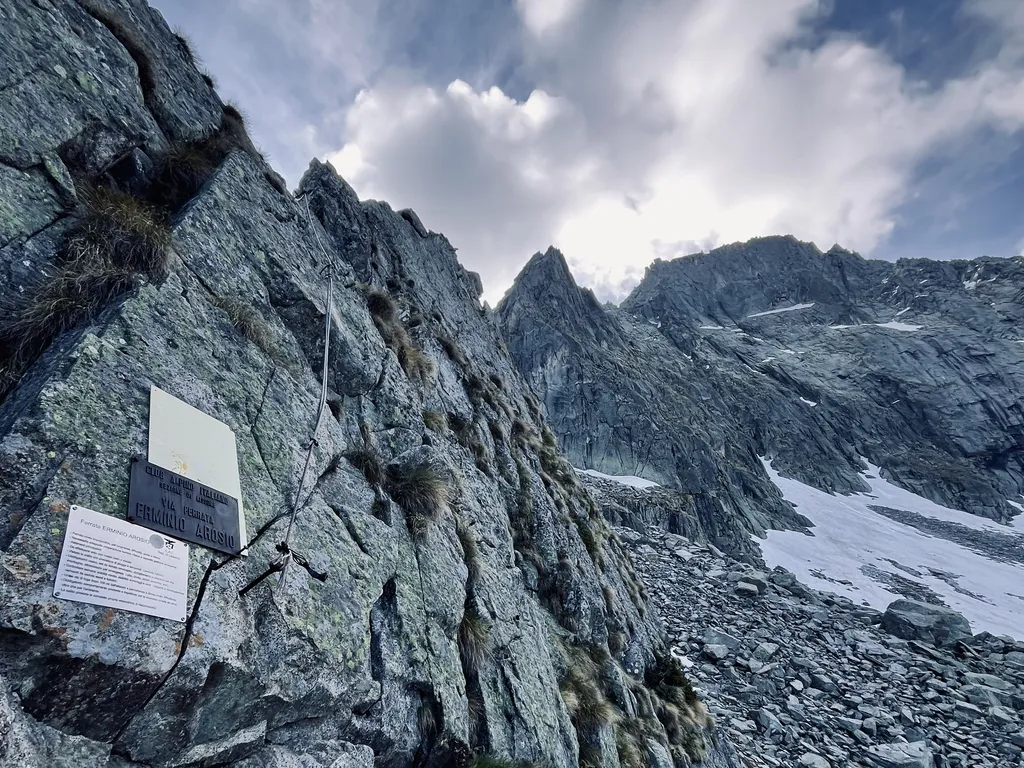
We moved to Aprica this year, and the first thing I wanted to know was what was actually within reach. Not the routes that show up on every “best via ferratas in the Alps” list – the ones with real challenge that nobody talks about. Ermini Arosio was one of them.
End of May. Clear morning, some scattered cloud, colder than average for the season with plenty of late snow still hanging around. Starting early meant the sun stayed behind the ridge for most of the ferrata, then mostly hid behind cloud after that. Cold enough that I expected to feel it – but between the climbing and the exertion, a t-shirt was enough the whole way.
Ermini Arosio is rated ED – extremely difficult, the top of the via ferrata scale – and it earns the rating differently than most hard ferratas do. Usually a via ferrata means clipping along a cable, semi-automatic, almost monotonous. This one flips that. The fixture points are so far apart that the cable stops being the thing you follow and becomes the thing that catches you if you’re wrong. The whole route, you’re reading the rock like a climber – sharp granite slab, almost no holds, constant exposure – not riding a handrail up the mountain.
Getting there is its own workout
Before any of that starts: 400 meters up the Adamello stairway from the parking to Rifugio di Lissone, then another 300 meters of ascent to the base of the ferrata. The markings here are easy to lose – worth paying attention, because getting off track before you’ve even started isn’t how you want to open a day like this.
On the ridge
No flat section. No point to stop, breathe, and reset. Every move is a decision – where the rock holds, where it doesn’t, whether the next bolt is close enough to matter if you get it wrong. It’s as mental as it is physical. Somewhere past the halfway mark you stop thinking about the summit and start thinking about the next three meters. That’s the route doing exactly what it’s built to do.
Via ferrata Ermini Arosio ends about 30 meters below the true summit of Corno di Grevo. In good conditions you can scramble the rest fairly safely if you want the peak.
The descent is where it actually gets you
A short cabled wall drops you straight toward a narrow couloir – two or three meters across at the top, where you need to cross it. Still holding a few meters of snow. Looking down, there was no visible end – no way to tell where it went or what it ran into. Very steep, somewhere around 60-70°. A slip there would have been deadly, and I knew it. I stood at the top and seriously considered turning back and re-climbing the ferrata instead. The couloir had locked every bit of my focus – for those few minutes I didn’t look anywhere but down at it, working out whether I could survive going down.
Eventually I pulled myself together, took a breath, and almost started down. Only at the last second did I finally look up – and there it was, right in front of me the whole time: warning paint and arrows, huge, telling me not to descend it at any cost. Cross it. Climb the wall on the other side.
Once I was past that, the route continued through Passo di Forcel Rosso and into a second couloir – longer, wider, less steep at around 45-50° by my own estimate, but still no easy walk down. The snow here had gone to a kind of wet, collapsing sorbet, mixed with loose rock and giving way to scree further down. On foot, without crampons, descending it properly was close to impossible.
What I had instead was a broken trekking pole – so I sat down and used it as a makeshift ice axe, controlling my speed on the way down rather than building up momentum I couldn’t stop. Long. Cold, in the specific way only a wet couloir can make you cold. At the bottom, a stretch of rockfall with no markings at all – I knew roughly where I needed to exit to rejoin the path, and picked my way through.
Gear notes
No artificial holds anywhere on this route, so footwork matters more than usual – climbing shoes are worth considering in warm-season conditions, or at minimum a boot with a proper climbing zone. If the couloir is still holding snow, bring crampons, and an ice axe if you have one – I didn’t, and I felt it. Check the via ferrata gear guide if you’re building a kit for something at this level. And if you’re glissading the snowy couloir like me, thicker softshell pants will save your ass.
Is Ermini Arosio worth it?
My first thought back at the car was that this might be the best via ferrata I’ve done – and I’m not sure anything tops it. That comes with a caveat: the descent. I don’t usually repeat routes – there’s always somewhere new to go. But Ermini Arosio might be the exception.
Technical route information, parking directions and GPX on ferrate365 webpage.