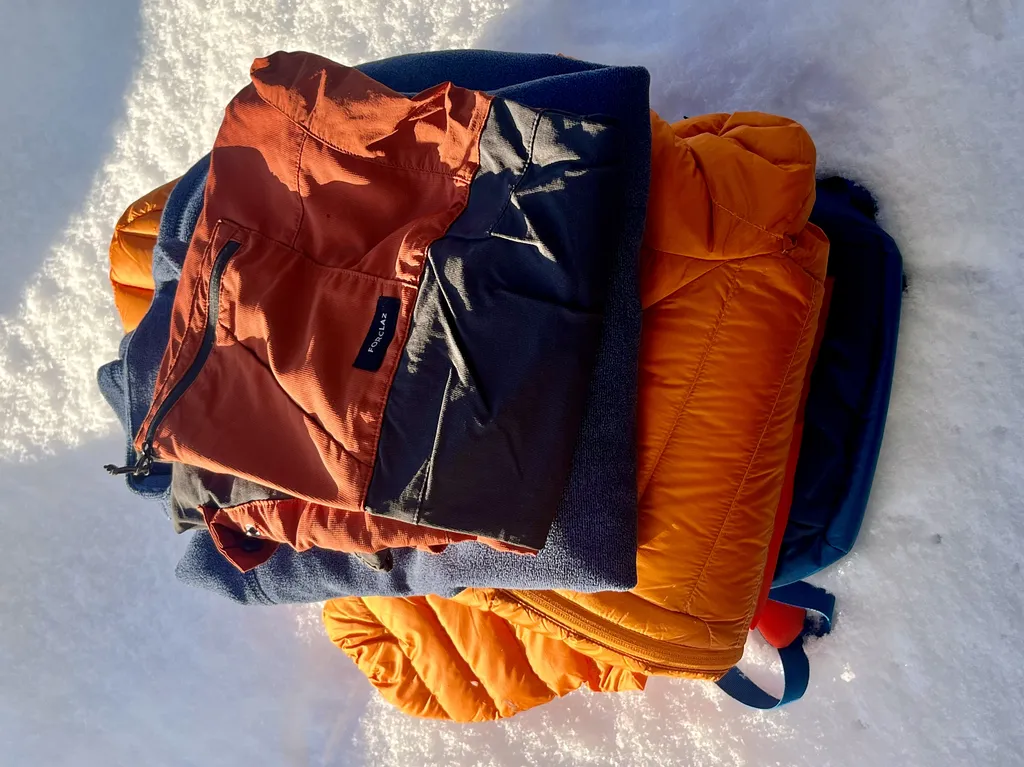
Search “layering system for mountaineering” and you’ll find no shortage of advice – base layer, mid layer, shell, repeat, dressed up a hundred different ways across a hundred different sites.
None of it matters.
That’s not a dig at the people writing it. It’s that a layering system is not a formula you can copy – it’s a combination that works for your specific body, and only you can find it through your own trial and error. What actually helps is knowing what to try first, based on how your body runs.
Why Your Layering System Isn’t Mine
I run warm. That’s the starting point for everything else: don’t overdo the layers, keep them easy to add and remove, lean on thinner layers instead of a few thick ones. In practice, that means a merino top or just a t-shirt, a light technical fleece with a grid pattern, and a windbreaker, down puffy, and hardshell riding in the pack rather than on my back. The windbreaker does double duty – wind protection and a bit of insulation. For most summer mountaineering days, that’s the whole system. The puffy and hardshell stay packed for when it turns properly cold, or the weather breaks.
That’s what works for me, built from experience – I know what my body does at temperatures as low as -60°C, and as high as +45°C, and how that changes in different humidity and under load versus standing still. Moving hard changes everything about how the layering system performs, so my main concern most days isn’t staying warm, it’s not overheating. Breathability becomes the priority.
But breathability only covers half the problem. The flip side is planning for the moment movement stops – an injury, a forced wait, anything that turns exertion into stillness. What do I need to not freeze if I suddenly can’t move at all? For me, that answer is an emergency bivy, carried over everything else. But that’s my answer, built from my own cold tolerance and my own margins – not something to copy from a stranger online. Cold tolerance varies from person to person, shaped by body composition, sex, and acclimatization, not just willpower – someone who runs cold might need a hardshell over a puffy in conditions I’d handle in a fleece.
The same logic runs through every piece of gear. I save my warmest socks and old Sorels for Arctic trips. Meanwhile, my partner might put the same socks on to sleep in on a hot summer night.
Start Paying Attention
Start paying attention to yourself on your next ordinary outing, not a major one. Where does the cold actually reach you first – hands, feet, the back of your neck? Do you sweat through a layer on the way up, then freeze the second you stop moving? Does cold hit you the moment you slow down, or only after you’ve been standing still for a while? Do these factors change depending on your body’s condition that day, or where you are in your cycle? How long can you stay still before the cold creeps in, and at what temperature?
None of that requires an expedition to figure out – a normal training day or an easy hike gives you the same information, and it’s the only data that actually matters. Notice it once, and you’ll know more about your own body than any gear guide could tell you.
So the real question isn’t which system to copy. It’s simpler and harder than that: where do you run warm, and where do you run cold? Your legs, your head, your hands – each one has its own answer, and none of them come from a gear guide. Check out the clothing page in the gear guide for what I actually use – but the system underneath it, you have to build yourself.