SlinGS
Slings are the most adaptable thing on your rack. A loop of webbing does not look like much, but depending on length and how you rig it, the same piece of gear builds an anchor, extends protection, backs up a rappel, or becomes a quickdraw. Understanding the material and length tradeoffs is what makes them useful rather than just extra weight.
Slings come in two materials: nylon and Dyneema (Ultra-High-Molecular-Weight Polyethylene).
Nylon is slightly stretchy, which means it absorbs some impact force. It's more abrasion-resistant, easier to work with when tying knots, and cheaper. The downside is weight and bulk, and it absorbs water, which matters in alpine and winter conditions.
Dyneema is significantly lighter and stronger for its weight, water-resistant, and packs smaller. The tradeoff is that it has almost no stretch, meaning it absorbs very little impact force on its own. It should never take a direct fall load. Use it as part of an anchor or as an extension, not as a standalone fall absorber. Dyneema is also difficult to tie knots in, and doing so weakens it significantly. I carry mostly Dyneema for the weight savings, mostly in 60cm and 120cm lengths.
One more thing on material: width. Wider tape is easier to handle and grip, which matters for sport climbing and anchor work. Narrower tape is lighter and racks more cleanly, better for alpine.

What slings do
Extending protection - placing a sling on trad gear reduces rope drag and prevents protection from being pulled out by rope movement. On wandering routes, longer slings keep the rope path cleaner.
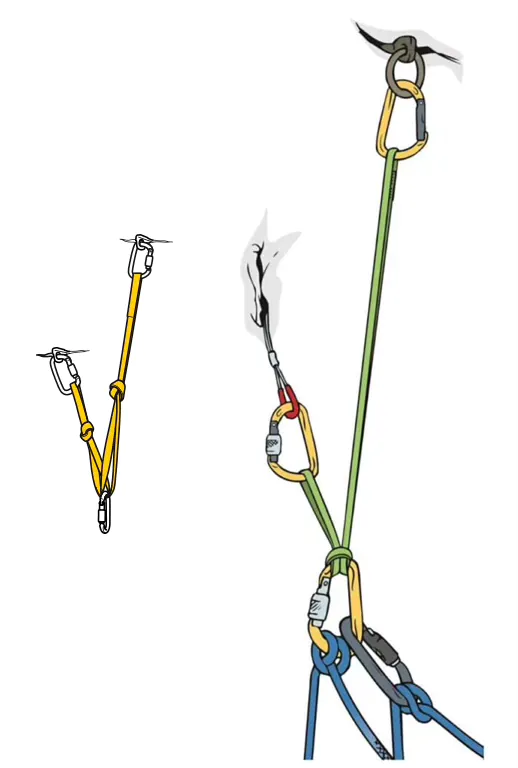
Building anchors - equalizing multiple anchor points on a belay ledge or top-rope setup. Common configurations include the sliding-X, quad, and pre-equalized knots. A 120cm sling covers most anchor situations.
Natural features - wrapping a sling around a tree, horn, or boulder creates a quick anchor without hardware. One of the most useful techniques to have dialed.
Personal anchor system - clipping into a belay station or rappel anchor while you sort gear, transition, or bring up a second. A 60cm or 120cm sling works for this depending on the situation.
Rappel backup - a sling tied as a prusik around the rope gives you a friction backup on descent. For this, shorter slings or dedicated cord work better than long ones.
Alpine quickdraws - a 60cm sling with two carabiners, racked doubled, extends when the route wanders. Covered in more detail on the quickdraws page.
Care and inspection
Check slings regularly for fraying, fading, or stiffness. UV degrades both materials over time, so store them away from direct sunlight. Any sling that has taken a high-impact load or shows visible damage gets retired.
And a note on linking slings: girth hitching two slings together reduces their combined strength noticeably. Use a carabiner to connect them instead.
More: sling connection test
The Black Diamond QC Lab piece on connecting two slings is worth reading before you start improvising with linked slings. The strength reduction numbers are more significant than most people expect.