Aid Climbing Gear
What is aid climbing gear?
In trad climbing, gear protects you from a fall but plays no role in moving upward. Aid climbing flips that: the gear is how you move. Every placement of aid climbing gear becomes a step, and progress up the wall depends on the quality and sequence of those placements. It's a different discipline with its own toolkit, most of which overlaps with trad gear but includes several pieces found nowhere else.

Pitons
A piton is a metal spike hammered into a crack or seam, with an eye or ring at one end for clipping a carabiner. They predate most modern protection and are still the only aid climbing gear option in placements too thin, shallow, or blank for anything else. Hammered pitons damage rock, which is why clean aid climbing avoids them where possible.
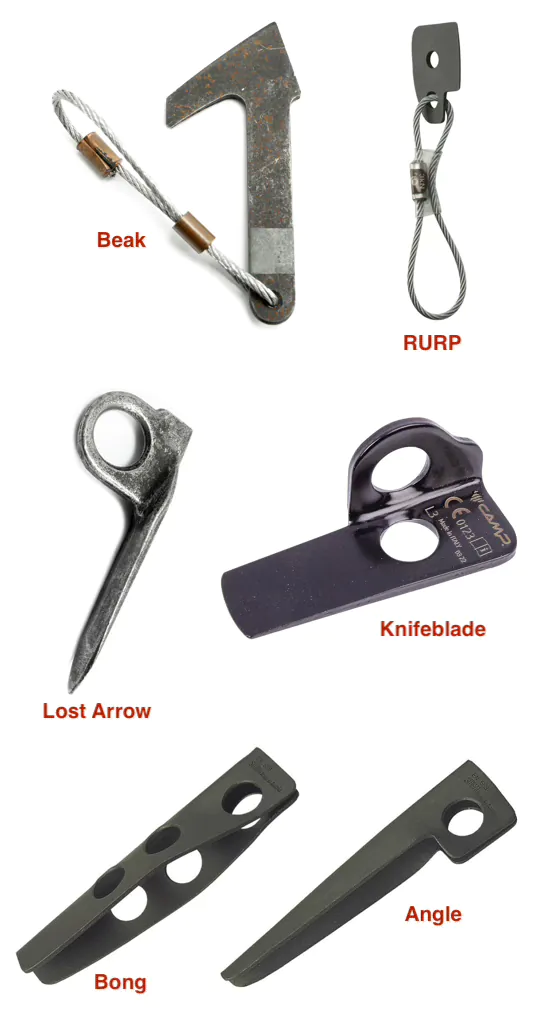
From smallest to largest:
RURP (Realized Ultimate Reality Piton) - postage-stamp sized, for the thinnest, shallowest seams. Marginal strength, used in aid or on extreme free routes where nothing else fits.
Beak (Birdbeak, Pecker, Tomahawk) - a thin hooking piton for thin cracks. Can be placed without a hammer in some placements.
Knifeblade (Bugaboo) - thin and straight, for thin deep cracks.
Lost Arrow - hot-forged and tapered, for medium cracks.
Angle - steel sheet bent into a U, V, or Z shape. Works in larger cracks where the steel deforms elastically on placement. Effective in wide placements.
Bong - the largest pitons, aluminium angles named for the sound they make going in. Largely replaced by cams and nuts, which hold better and don't damage the rock.
Hooks
Hooks don't go into cracks. They sit on edges, flakes, and features of the rock, held in place by body weight and the geometry of the placement. Run your fingertips along the rock to find a depression or incut that will seat the hook securely.
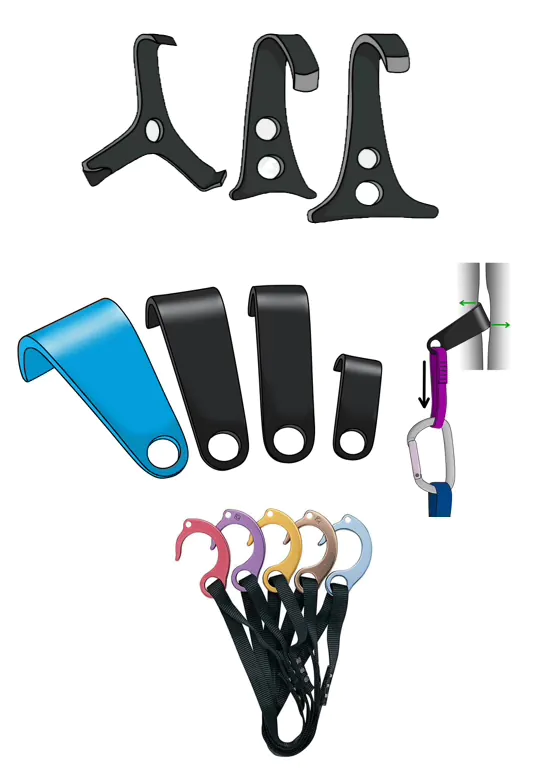
Skyhooks come in three common sizes: Bat/Talon (small), Cliffhanger (medium), and Grappling (large). Carrying two of each size allows consecutive moves on the same feature without resetting.
Cam hooks fit into small cracks and cam against the walls under body weight, similar in principle to a cam but without moving parts. Work in vertical, diagonal, horizontal, and even inverted placements. Reduce the need to hammer a piton in many situations.
Fifi hooks are question-mark-shaped tools that clip quickly into gear to take body weight during rest or transitions. They offer very little strength and should be used with care and a retrieval cord.
Aiders
Aiders are webbing devices clipped to protection, bolts, or ascenders to create artificial footholds. They are what turns a piece of aid climbing gear into a step upward.
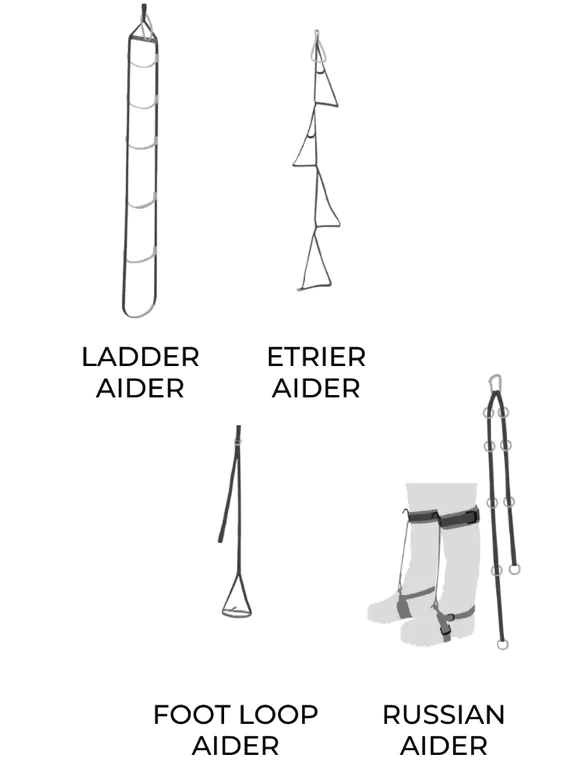
Ladders have parallel sides with horizontal box-shaped steps. The standard for big wall and sustained aid climbing where you need stable, consistent footing over long sections.
Etriers have triangular steps alternating on opposite sides of the webbing. More compact than ladders, used in alpine and mixed aid situations.
Foot loops are a single adjustable triangular step on a cord. Used as a backup, in route setting, and in crevasse rescue kits where a full aider is too bulky.
Russian aiders use metal hooks on stirrups that walk up rings sewn into separate webbing, clipped to protection. Suited for overhanging and awkward aid positions.
Daisy chains
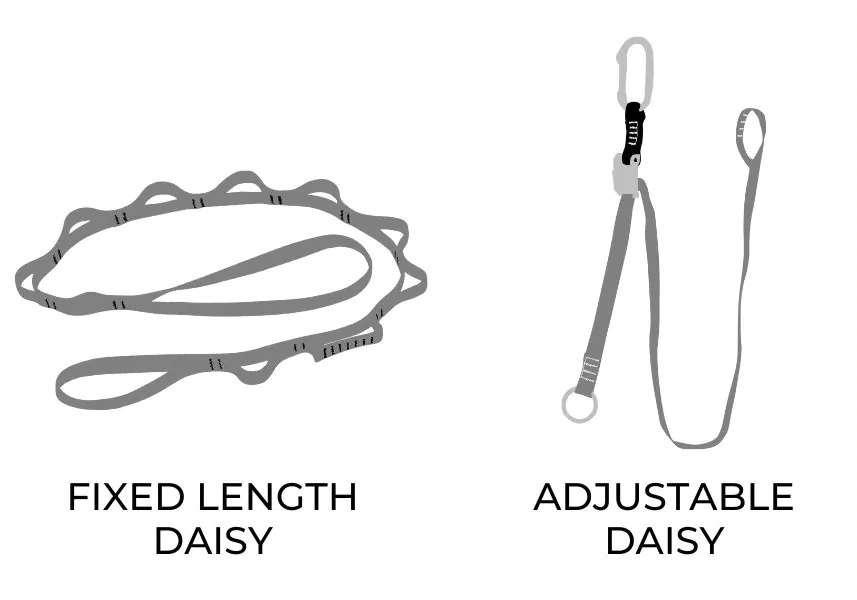
Daisy chains are sewn webbing loops used to connect temporarily to a piece of protection while aid climbing. They hold body weight and allow progress to be captured while you move through the system.
An important thing to know: daisy chains are not tested or certified as climbing gear, and they should never be used as a personal anchor. They are a progress-capture tool within a larger system, not a standalone safety device. Black Diamond's QC Lab piece on daisy chain dangers is worth reading before you use one.
Fixed length daisy chains clip into progressively higher pockets to capture upward movement and reach the next placement.
Adjustable daisy chains allow the connection point to be tightened or loosened as you move up or down in the aiders, which is useful when body position needs to change.