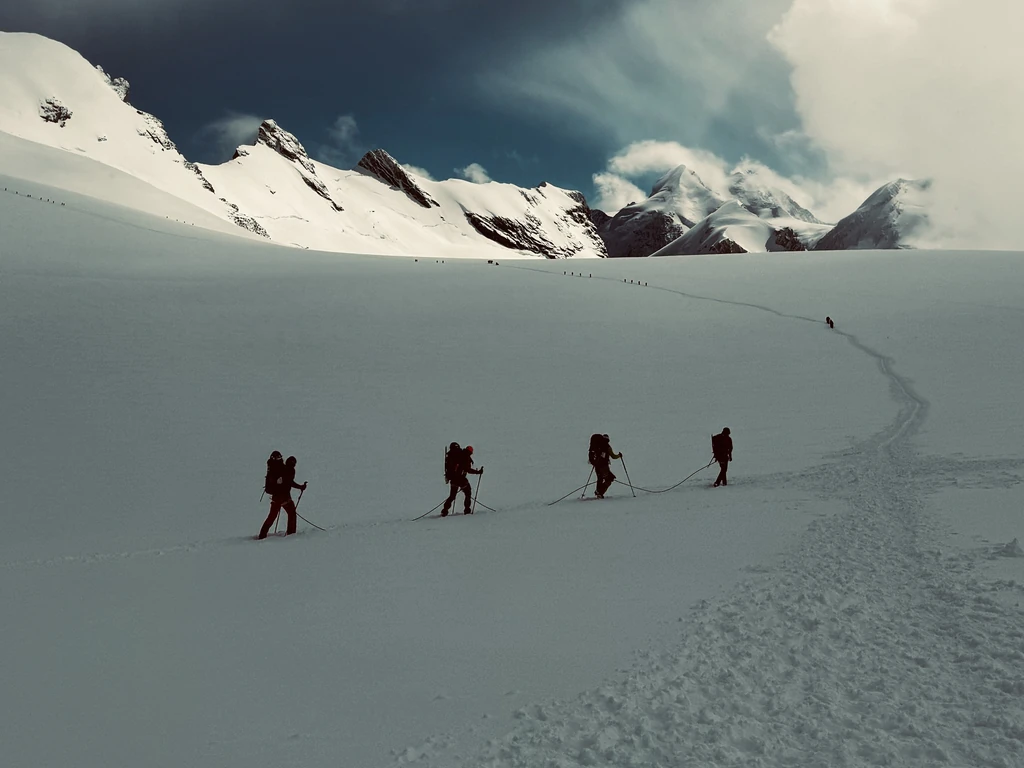
The moment you step off a hiking trail onto a glacier or technical terrain, the alpine skills you need change completely. The ground moves differently, the consequences of a slip are different, and the skills you need are different too. Here’s what you actually need to learn – and how to start practicing most of it without leaving home.
Essential Alpine Skills
Anyone moving onto technical terrain – glaciers, steep snow, anything beyond hiking – should know these five basics before they go: walking in crampons, self-arresting with an ice axe, roping in and basic knots, crevasse rescue fundamentals, and mountain nutrition and survival. Not optional. Not something to figure out on the day.
Not everyone has access to an alpine technique course or a glacier to practice on. But most of these skills can be started at home or on a muddy hill – and that’s exactly the point.
Walking in Crampons
Walking in crampons doesn’t come naturally – the added length under your boots creates an unfamiliar feeling, and the spikes catch on rocks, ice, and soft snow unevenly. Without rigid mountaineering boots, that unevenness would mean twisted ankles. With them, it just means practice.
Find a muddy slope with some rocks mixed in. Walk up, down, and across it. Practice on both hard and soft surfaces. The goal is simple – make the spikes feel like extensions of your feet, not obstacles.
Self-Arrest: Stopping a Fall
Of all ice axe techniques, self-arrest is the most important one. It’s what stops you sliding down a slope when you fall – and on steep snow or ice, an uncontrolled slide doesn’t end well.
The basics can be practiced anywhere with a slope and some mud. Wear old clothes, find a hill, and practice falling and stopping:
- From any starting position, force yourself onto your stomach.
- Hold the axe head over one shoulder, pick turned away from you, shaft across your body.
- Drive the pick into the ground using your bodyweight.
- Add pressure with your body and brake with your feet.
Repeat until it’s instinctive. On a real slope, you won’t have time to think.
Roping In and Knots
Rope skills are the easiest to practice at home – all you need is a rope and time. The goal is to reach the point where you can tie any of these without thinking, in gloves, in the dark if needed.
Start with these:
- Figure 8 – your primary tie-in knot
- Bowline – tie-in alternative, also useful for retrievable anchors
- Alpine butterfly – for attaching a middle person on a rope team
- Double fisherman’s – for joining two ropes or making prusik loops
- Clove hitch – quick and adjustable, used constantly for anchoring to bolts and pitons
- Munter hitch – a belay and rappel backup when you have no device
- Prusik hitch – for ascending a rope or crevasse rescue systems
- Rope coiling – because a tangled rope at the wrong moment is its own emergency
Crevasse Rescue
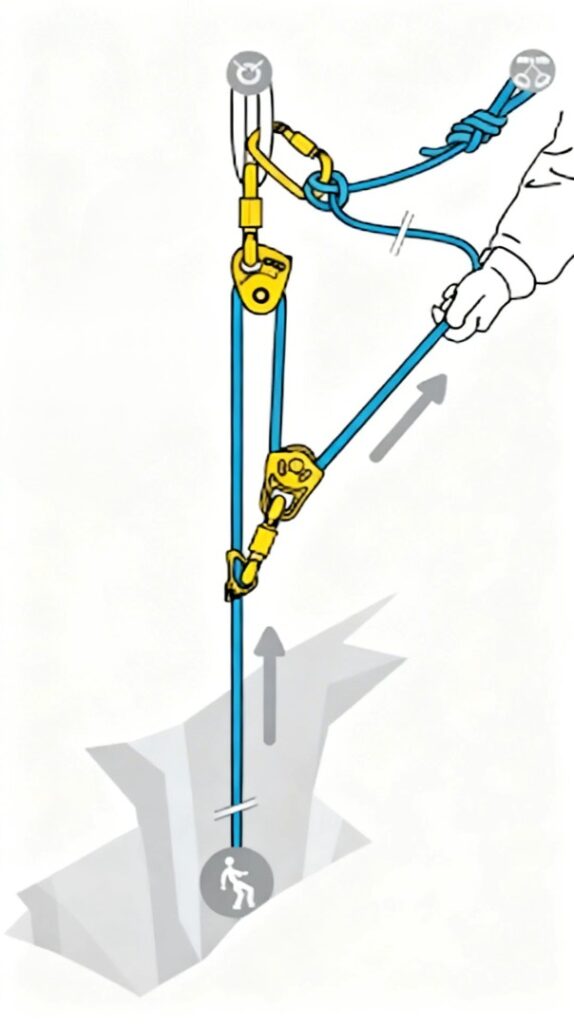
This is one of the hardest alpine skills to practice without proper infrastructure – but also one of the most crucial. Picture this: you’re on a glacier heading toward your first 4000m peak, and your partner falls into a crevasse. You self-arrest successfully. Now what – especially if they’re unconscious and hanging on the rope?
Theory alone won’t save anyone. This needs to become instinct. One creative way to practice: a children’s sandbox. The feel is closer to snow than most surfaces, you can bury an ice axe as an anchor, and with a longer rope, a few carabiners and prusik loops you can work through 2:1 and 3:1 pulley systems until the logic is second nature. Once it is, upgrading to 5:1 systems and proper rescue tools won’t be a challenge.
Nutrition and Survival at Altitude
Altitude and cold change how your body works in ways that catch most beginners off guard.
Fuel: your body burns through energy significantly faster in cold and at altitude. Eat a proper warm meal before you start and another at the end of the day – and carry nutritious snacks to fuel consistently through the hours in between. Don’t wait until you’re hungry.
Hydration: cold and altitude suppress your natural thirst response – you won’t feel dehydrated until you already are. Force yourself to drink regularly regardless of thirst. Many mountaineers use electrolyte tablets to make water more palatable and replenish what the body loses.
Medkit: carry at minimum – bandages of different sizes, ibuprofen, antihistamines, wide-spectrum antibiotics, digestion aids, active charcoal, and Bepanthen for skin. Add an emergency blanket or bivy depending on the objective. Know what everything in your kit is for before you need it.
One important note: blood clotting is slower at altitude. Even a minor cut takes longer to stop. Apply pressure longer than you think necessary.
This vast topic deserves its own article – but these are the basics you need before stepping onto a glacier.
The Learning Never Stops
Will all of the above be enough? Not always – mountains are unpredictable by nature. But these alpine skills significantly increase your chances of a safe and successful adventure compared to going without them. And once you’ve walked your first glacier, you’ll quickly discover how much more there is to learn.
Mountains require respect, focus, and preparation – and that preparation often begins not at the trailhead, but at home, long before the trip.
Know crucial alpine skills I missed? Or planning your first glacier trip and not sure where to start – find me on Instagram.